
Math and Art series Part II: Einstein tiles

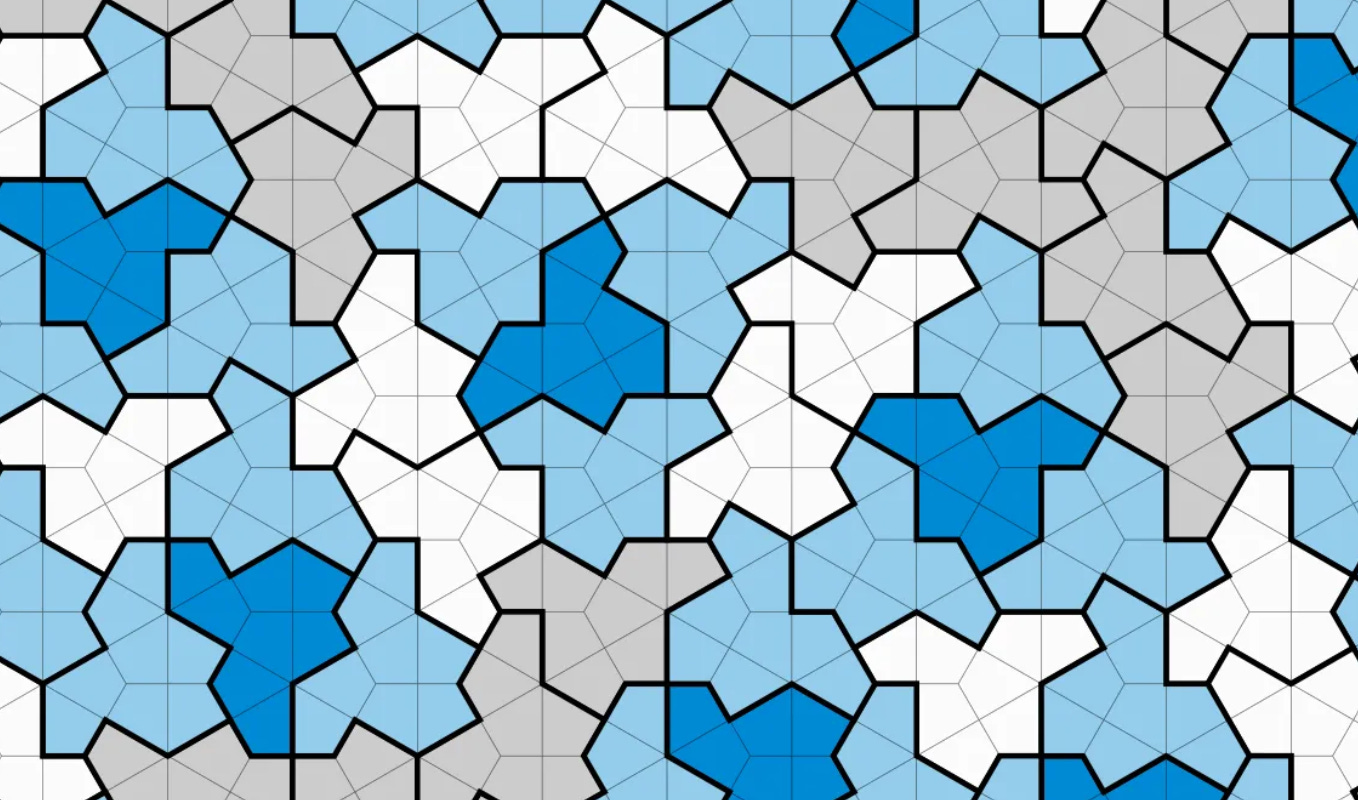
Building on the previous post with the Celtic knots, I thought it would be interesting to turn it into a (not particularly strictly ordered) series, so we number this as Part II. The goal is to provide a gentle exploration of the connection between mathematics and art through some fun topics, without getting too much into detail.
Anyone who has tiled a bathroom wall or worked on a jigsaw puzzle is familiar with the concept of tessellation (or tiling). Tessellation is the process of covering a surface with one or more geometric shapes in such a way that:
There are no gaps left, and
There is no overlap between the pieces.
While this can be done simply with square tiles, tessellations can also be created in more interesting and less regular ways. Examples of this can be found in the works of Maurits Escher.
We can also consider an additional property of tessellations: aperiodicity. Although aperiodicity is a subtle concept, it means patterns on an infinite plane never repeat when shifted. We have known some time this is possible using multiple tiles. For example, in the 1970s, Roger Penrose introduced Penrose tilings, which cover the plane aperiodically using at least two distinct shapes.
Mathematicians had wondered for a very long time whether a single-tile (monotile) aperiodic tessellation was possible, until this question was finally answered in 2023. Hobby mathematician David Smith discovered the “hat”, which showed this was possible (with reflections). Later, another related shape, called the “spectre” or “vampire”, was discovered, which does not need reflections. These shapes were mathematically proven to satisfy the requirements for aperiodic tiling.
The reason they are referred to as “Einstein” tiles is that “ein Stein” means “one stone” in German (a pun).
An Einstein tessellation can be seen in the image.
(Aperiodic tiling by hats by David Smith, Joseph Samuel Myers, Craig S. Kaplan & Chaim Goodman‑Strauss — CC BY 4.0)
Great post. Mathematicians are artists too in a sense. It's actually the studying of historical mathematical papers that got me into philosophy and art which is rather strange: Euclid's elements and Newton's Principia Mathematica can be considered both artistic and scientific masterpieces.
this was such an insightful read. and if anyone enjoys art-focused reflections, my substack is open too ✨