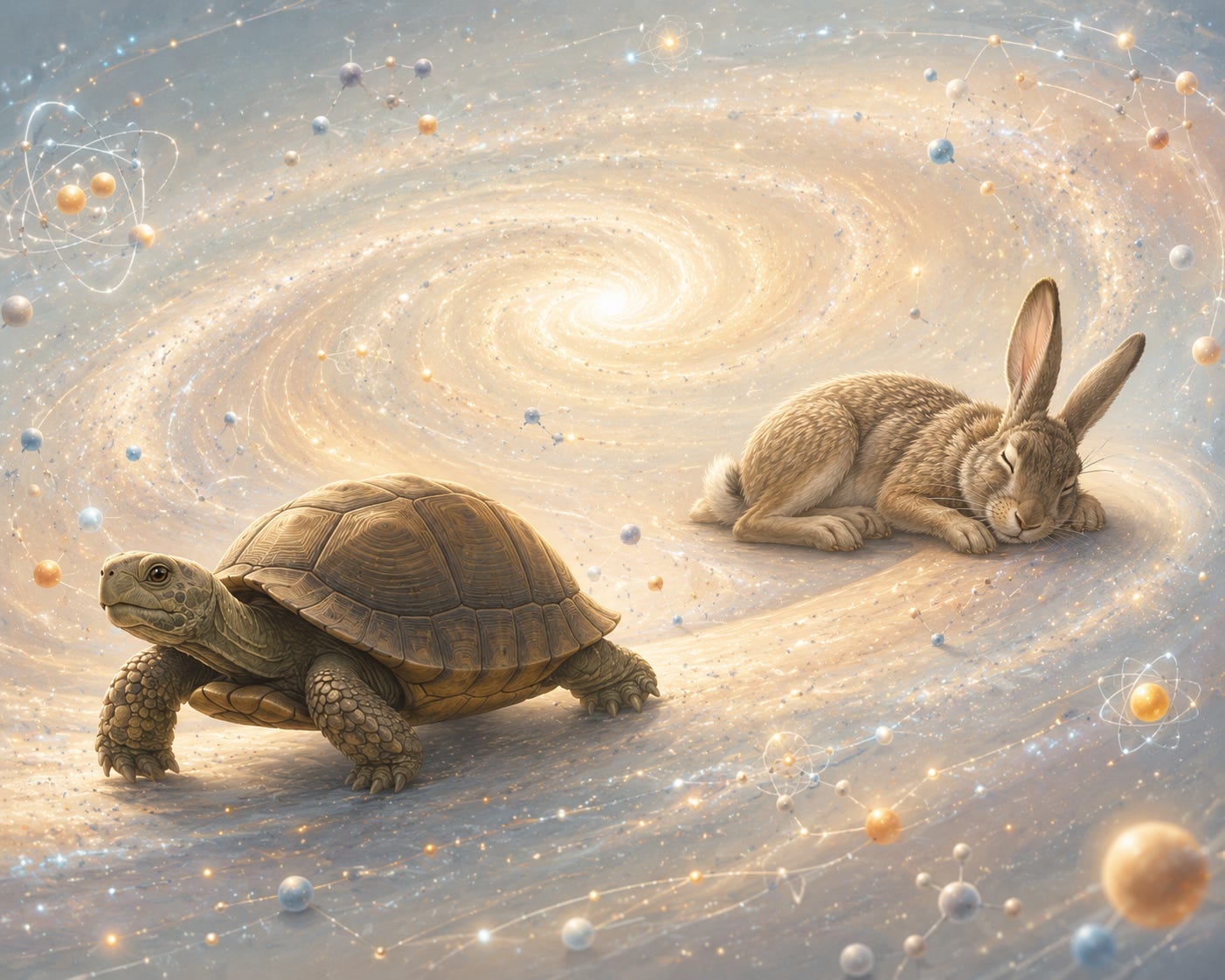
On the Tortoise, the Hare, and Continuous Motion (Part I)

(In this part, I want to get into a concrete and practical aspect of staying in motion, while in the second part I will explore the broader theme of motion itself.)
Discussing the theme of motion, my brother told me life is much more like a marathon than a sprint. In a marathon, one cannot go all-out, but the art lies in pacing oneself—finding a pace that is sustainable over a longer distance, yet still challenging. The key is to stay in motion, as it seems particularly hard to regain momentum once one stagnates.
This insight reminded me personally of the fable of the tortoise and the hare. While most will be familiar with it, it is useful for completeness to remind readers of the tale. In the story, a fast and arrogant hare mocks a slow tortoise and challenges him to a race. The hare sprints ahead easily and, believing he cannot lose, decides to rest. While the hare sleeps, the tortoise keeps moving and, by the time the hare wakes up and rushes forward, the tortoise has already crossed the finish line. This simple allegory provides many life lessons—some that are apparent at first sight, like the idea that persistence can outperform talent, and many more that reveal themselves only with deeper reflection.
The hare, in a way, symbolizes speed, talent and the naturally advantaged individual — someone for whom early progress often feels effortless and who is able to learn and develop quickly. The tortoise, on the other hand, could be seen to represent the hard‑working type who needs serious effort to cover distance.
Earlier in life we might see the hare as the embodiment of a winner, possessing the necessary characteristics for any ambition. In a way, it is hard to imagine someone so fast, so seemingly effortless in their progress, ever losing pace. And if life were a sprint, this would indeed be the simple conclusion of the tale.
However, reality unfolds differently. Many talented people somehow, and perhaps even strangely, end up coming to a standstill. Examining the trajectory of many talented people I have gotten to know, one can observe that they resemble hares far more than tortoises. They possess the intrinsic ability to move fast, to accelerate quickly, and to achieve early peaks — yet somewhere along the way, many of them begin to stagnate. In this contrast, one sees the virtue of the tortoise — the steadiness of the hard‑working type, the kind of person who persists, and more broadly, one who never doubts that the finish line can be reached.
Looking more broadly and generally, one can see the finish line as a hypothetical point that exists only in the mind at first — an imagined destination that must be envisioned and believed in before one can move toward it. The tortoise doesn’t only embody persistence but also that belief, even when all others are doubtful and the finish is neither visible nor concrete, perhaps not even more than an abstract destination.
In this context we have to notice that we are living in times in which all meaningful endeavors have a long‑term horizon, as in a way most easy things have already been done. Additionally, another reason real change is hard to achieve is that we nowadays often operate in environments shaped by established cultures, processes, and beliefs. These environments are inflexible and make progress arduous. So the necessary characteristic for any meaningful achievement is not speed but a commitment — in mind and body — to continuous motion.